
Raw Dog Food Diet: Pros, Cons, Costs, and How to Start Safely in 2026
My neighbor switched her Golden Retriever to raw food last spring, and within a month she was telling everyone at the dog park that it was the best decision she had ever made. The dog's coat was shinier, she said. His teeth were cleaner. He had more energy. He pooped less. Then, three weeks later, the same dog was at the vet with bloody diarrhea, and the vet found Salmonella in his stool and a piece of bone lodged in his intestine. The bill was $1,400, and the raw diet went straight into the trash.
Both stories are true, and that is the honest shape of raw feeding. It can work well, and it can go badly wrong, and the difference is almost never the idea itself — it is the execution. A raw diet done carefully, with the right ratios and the right hygiene, is a legitimate way to feed a dog. A raw diet done casually, with a freezer full of chicken backs and a guess about portions, is a vet bill waiting to happen. This guide gives you the honest version: what raw feeding actually is, what it costs, what the evidence says it does and does not do, the safety rules that matter, and a two-week plan to switch without making your dog sick.
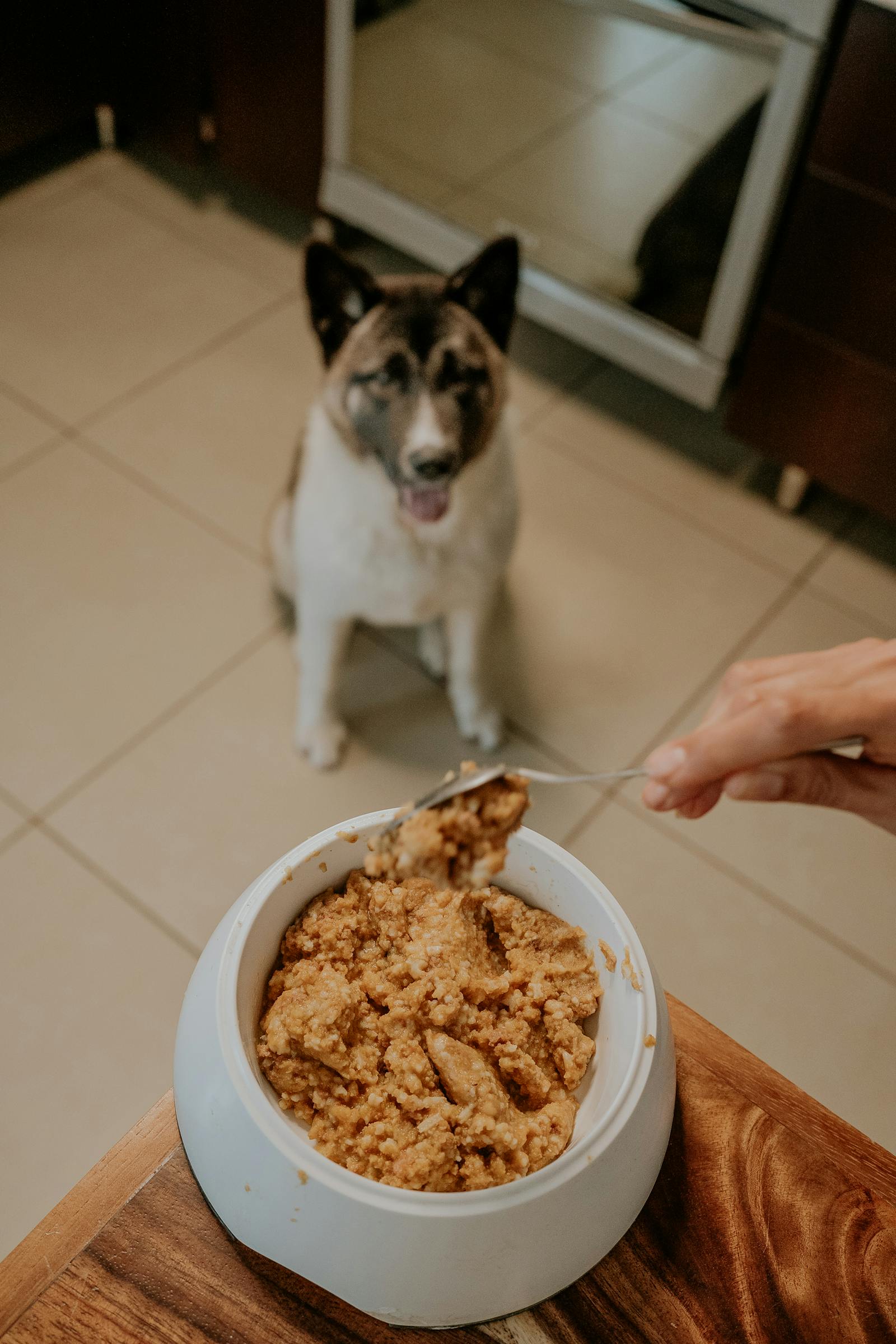 |
| A dog waiting for a homemade meal — raw feeding takes real preparation, not just a bowl of meat from the freezer. Photo: Pexels. |
The Short Answer
A raw dog food diet means feeding uncooked meat, bones, organs, and sometimes vegetables and eggs, instead of kibble or canned food. In 2026, it costs $150 to $400 a month for a medium-sized dog, depending on whether you buy pre-made commercial raw or do it yourself — roughly two to four times the cost of a good kibble. The diet can produce a shinier coat, smaller stools, and cleaner teeth, but the claimed benefits most owners hope for — a longer life, fewer allergies, a stronger immune system — have not been proven in controlled studies. The risks are real and documented: bacterial contamination, unbalanced nutrition, and choking or intestinal injury from bones.
Raw feeding is not a fad, and it is not a scam. It is a high-effort, high-cost, higher-risk way to feed a dog that works for some owners and some dogs, and is a bad idea for others. The rest of this guide is about figuring out which group you are in before you spend the money.
What a Raw Diet Actually Is
The idea behind raw feeding is simple: dogs evolved eating raw prey, so a diet of raw meat, bones, and organs is closer to what their bodies expect than processed kibble. The modern version of the idea has two main models, and they are quite different.
The BARF model — Bones And Raw Food, or Biologically Appropriate Raw Food — is the structured version. A typical BARF bowl is about 70 percent muscle meat, 10 percent raw meaty bones, 10 percent organs (half liver, half other organs like kidney or spleen), and 10 percent vegetables, fruit, seeds, and supplements like fish oil. The vegetables are usually pureed, because dogs cannot digest raw plant cell walls well. BARF feeders often add raw eggs, yogurt, and kelp. This is the model most commercial raw brands follow, and it is the one with the best chance of being nutritionally complete.
The prey model — sometimes called whole prey or frankenprey — is simpler and stricter: roughly 80 percent muscle meat, 10 percent bone, 5 percent liver, and 5 percent other organs, with no vegetables, no fruit, and no grains. The idea is to recreate a whole animal, piece by piece, over the course of a week. It is cheaper and simpler to prepare, but it is also easier to get wrong, because there is no margin for error — if you skip the organs for a few weeks, the dog is missing nutrients that kibble would have supplied automatically.
Both models are usually fed at 2 to 3 percent of the dog's body weight per day. A 50-pound dog eats about 1 to 1.5 pounds of raw food a day. A 20-pound dog eats about 7 to 10 ounces. Puppies eat more — 5 to 10 percent of body weight, because they are growing — and less active or overweight dogs eat less.
What a raw diet is not: it is not just feeding your dog raw chicken from the grocery store. A diet of muscle meat alone is dangerously unbalanced — too much phosphorus, not enough calcium, almost no vitamin E, and no iodine. The dogs that get sick on raw diets are very often the ones whose owners fed meat and forgot the rest.
What Raw Feeding Costs in 2026
Raw feeding is expensive, and the price depends heavily on whether you buy pre-made or do it yourself, and on how big your dog is.
Commercial pre-made raw: $200–$400 a month
Pre-made raw food comes frozen in patties, nuggets, or tubs from brands like Stella & Chewy's, Primal, Instinct Raw, Darwin's, and We Feed Raw. The food is ground, mixed to a complete ratio, and often high-pressure processed (HPP) to reduce bacteria. It is the easiest way to feed raw, and the most expensive.
| Dog size | Weight | Pre-made raw per month |
|---|---|---|
| Small | 10–20 lbs | $120–$200 |
| Medium | 20–50 lbs | $200–$300 |
| Large | 50–90 lbs | $300–$450 |
| Giant | Over 90 lbs | $450–$650 |
A 50-pound dog eating Primal or Stella & Chewy's costs about $8 to $12 a day. The same dog eating a premium kibble costs $2 to $3 a day. Over a year, that is roughly $3,000 versus $900 — a difference of about $2,100 a year, every year, for the life of the dog.
DIY raw: $150–$300 a month
Doing it yourself is cheaper, but only if you can buy in bulk and you have freezer space. The realistic monthly cost for a 50-pound dog is $150 to $250 if you buy from a butcher, a raw feeding co-op, or a wholesale meat supplier, and $200 to $300 if you buy retail at the grocery store. The ingredients break down roughly like this:
- Muscle meat ($2–$4 per pound): chicken thighs, turkey necks, beef trim, pork shoulder. The cheapest cuts are the ones that work best — nobody feeds raw filet mignon.
- Raw meaty bones ($1–$2 per pound): chicken backs, duck necks, turkey necks, beef ribs. These supply the calcium.
- Organs ($1–$3 per pound): beef liver, chicken liver, kidney, spleen. Organs are cheap, and they are the most nutrient-dense part of the diet.
- Supplements ($15–$30 a month): fish oil, vitamin E, kelp, and sometimes a commercial raw balancer. A balancer is a pre-mixed powder of vitamins and minerals that fills the gaps in a DIY diet, and for a beginner it is the single most important purchase.
The hidden costs of DIY are a chest freezer ($150 to $300, one-time, plus $5 to $10 a month in electricity), storage containers, a kitchen scale ($15 to $25), and your time — about 2 to 3 hours a week to portion, bag, and thaw meals. If you value your time at all, DIY raw is not as cheap as it looks.
The Real Benefits — and What Is Actually Proven
Raw feeding has passionate supporters, and some of what they say is true. But it is worth separating what is proven from what is hoped for, because the gap between the two is where people make expensive mistakes.
What is well supported: Dogs on raw diets usually have smaller, firmer stools, because raw food has less filler and less indigestible fiber than kibble. Many owners report a shinier coat and less shedding, which makes sense — raw diets are higher in fat and omega-3s than most kibble. Dental health often improves, because chewing raw meaty bones scrapes plaque off teeth in a way that kibble never does. And dogs that are picky eaters often eat raw food enthusiastically, which matters if you have a dog that has turned its nose up at three different kibbles.
What is not proven: There is no good evidence that raw feeding makes dogs live longer, prevents cancer, cures allergies, or strengthens the immune system. The studies that exist are small, short, and mostly funded by raw food companies. The largest studies of dog lifespan and diet have found that the single biggest dietary factor in how long a dog lives is body weight — lean dogs live about two years longer than overweight dogs — and that has nothing to do with raw versus kibble. A lean dog on kibble will outlive an overweight dog on raw, every time.
What is sometimes true and sometimes not: Some dogs with chronic digestive problems do better on raw food, usually because the diet is simpler — one protein, no grains, no additives — and the owner can control every ingredient. But other dogs with digestive problems get worse on raw, because raw fat is hard to digest and the bacterial load irritates an already sensitive gut. If your dog has a digestive problem, the answer is an elimination diet supervised by your vet, not a guess about raw versus kibble.
The honest summary: raw feeding reliably produces smaller stools, a shinier coat, and cleaner teeth. It does not reliably produce a healthier dog. If those three things are worth $2,000 a year to you, raw feeding may be worth it. If you were hoping for a longer life or a cure for allergies, the evidence does not support the price.
The Risks: Bacteria, Bones, and Unbalanced Nutrition
This is the section most raw feeding websites skip, and it is the one that matters most.
Bacteria. Raw meat carries Salmonella, E. coli, Campylobacter, and Listeria. Studies of commercial raw dog food have found Salmonella in 20 to 30 percent of samples, and Campylobacter in a similar share. Dogs often carry these bacteria without getting sick themselves — but they shed them in their stool, and they spread them around the house on their mouths, their paws, and their bowls. The risk is not just to the dog. It is to you, your children, and anyone with a weakened immune system who touches the dog or cleans up after it. The FDA and the CDC both advise against raw feeding for households with young children, elderly people, or anyone who is immunocompromised, and for a good reason: there have been documented cases of children getting Salmonella from a dog that was fed raw.
You can reduce the risk, but you cannot eliminate it. Thaw meat in the fridge, never on the counter. Wash your hands, the bowls, the cutting boards, and the counters after every meal. Disinfect the feeding area daily. Do not let the dog lick your face after eating. And never feed raw pork or wild game — pork can carry parasites that cooking kills and freezing does not reliably kill, and wild game carries the same problem plus lead from hunting ammunition.
Bones. Raw meaty bones are the calcium source in a raw diet, and they are also the most dangerous part. Cooked bones splinter and should never be fed. Raw bones are safer, but they are not safe. A dog can break a tooth on a weight-bearing bone from a cow or a pig — a femur, a knuckle bone — and a broken tooth costs $500 to $1,500 to fix. A dog can choke on a bone, or swallow a piece that blocks the intestine, and an intestinal blockage costs $1,500 to $4,000 in emergency surgery. The bones that are safest are raw, non-weight-bearing bones that match the dog's size: chicken necks and wings for small dogs, duck necks and turkey necks for medium dogs, beef ribs for large dogs. Never give a small dog a large bone it has to gnaw for an hour, and never leave a dog unsupervised with a bone.
Unbalanced nutrition. This is the slow risk, and the most common one. A raw diet that is not balanced causes problems that take months to show up: a calcium deficiency that weakens bones, a vitamin D deficiency, a zinc deficiency that causes skin problems, too much vitamin A from too much liver. Puppies are the most vulnerable — a puppy fed an unbalanced raw diet can develop skeletal problems that are permanent. If you feed raw, the diet needs to meet the AAFCO nutrient profiles, the same standard kibble must meet. The simplest way to be sure is to use a commercial pre-made raw that is labeled "complete and balanced," or to use a balancer supplement and follow a recipe from a veterinary nutritionist, not from a blog or a Facebook group.
Who should not feed raw, full stop: Puppies under 12 weeks, dogs with a weakened immune system, dogs on immunosuppressive medication, dogs with kidney or liver disease, and any household with a baby, a pregnant person, or someone undergoing chemotherapy. For these dogs and these households, the risk is not theoretical. It is the reason every major veterinary organization in the United States — the AVMA, the FDA, and the CDC — advises against raw feeding.
 |
| A Labrador enjoying a raw bone outdoors — bones supply the calcium in a raw diet, but the wrong bone for the dog's size can break teeth or block the intestine. Photo: Pexels. |
How to Switch to Raw Safely: A Two-Week Plan
If you have read the risks and you still want to try raw feeding, do it properly. A sudden switch is the most common reason the first week goes badly. A gradual switch, over two weeks, lets the dog's gut adjust and lets you spot problems early.
Days 1–3: One quarter raw. Feed 75 percent of the old food and 25 percent raw, mixed in the same bowl. Use a single protein — chicken is the usual starting point, because it is the easiest to digest. Watch the stool. A little softening is normal. Diarrhea, vomiting, or blood is not — stop and call your vet.
Days 4–7: Half and half. Feed 50 percent old food and 50 percent raw. Add the first raw meaty bone, sized for your dog — a chicken neck for a small dog, a duck neck for a medium dog. Watch the teeth and the stool. If the dog gulps bones whole instead of chewing, the bone is too small — go up a size.
Days 8–11: Three quarters raw. Feed 25 percent old food and 75 percent raw. Add the first organ meat — a small piece of liver, about 5 percent of the meal. Liver is rich and it loosens stools, so start small. Add the fish oil and the balancer supplement now, if you are using them.
Days 12–14: Fully raw. Feed 100 percent raw, at the full ratio: roughly 70 percent muscle meat, 10 percent raw meaty bones, 10 percent organs, and 10 percent vegetables and supplements if you follow the BARF model. Weigh the food for the first month — eyeballing portions is how dogs gain weight on raw, because raw food is calorie-dense and a "little extra" adds up fast.
For the first month, weigh your dog every week. A dog that loses more than 2 percent of its body weight in a week is eating too little. A dog that gains weight is eating too much. Adjust the portion by 10 percent at a time, not all at once. And book a vet check at the one-month mark — a blood panel costs $75 to $150, and it is the only way to know whether the diet is actually working or quietly causing a deficiency.
DIY or Pre-Made: Which One Should You Choose?
Choose pre-made if: you are new to raw feeding, you have limited time, you have a puppy, or your dog has a health condition. Pre-made raw is the safest way to start, because the ratio is done for you and the food is labeled complete and balanced. The extra cost is the price of not making a nutritional mistake.
Choose DIY if: you have been feeding raw for at least a few months, you have freezer space, you can buy in bulk, and you are willing to follow a recipe from a veterinary nutritionist and use a balancer. DIY is cheaper and gives you full control, but the control is only useful if you know what you are controlling. A DIY diet built from internet recipes is the most common way raw feeding goes wrong.
A practical middle path: many owners feed pre-made raw on weekdays and DIY on weekends, or feed raw for one meal a day and a high-quality kibble for the other. There is no rule that says raw feeding has to be all or nothing, and a half-raw diet is still a big change from kibble. If the full cost or the full effort is too much, a partial switch is a reasonable compromise — and it is far better than a full switch done badly.
What to Buy: A Starter List
If you decide to try raw feeding, here is what you actually need, with 2026 prices:
- A kitchen scale ($15–$25). Portions are by weight, not by eye. This is not optional.
- A chest freezer ($150–$300). A 5-cubic-foot freezer holds about a month of food for a medium dog. Buy it used if you can — raw feeders sell them constantly.
- Freezer bags or containers ($10–$20 a month). Portion meals into daily bags so you can thaw one bag at a time.
- A commercial balancer ($20–$35 a month). Brands like Balance IT or JustFoodForDogs Nutrient Blend. This is the insurance policy for a DIY diet.
- Fish oil ($10–$15 a month). For omega-3s. Keep it in the fridge.
- Stainless steel bowls ($15–$25). Easier to disinfect than plastic, which scratches and harbors bacteria.
- A meat supplier. Ask your butcher about bulk prices, look for a raw feeding co-op in your area, or check suppliers like Raw Feeding Miami, Hare Today, or My Pet Carnivore online. Co-ops cut the price by 20 to 40 percent, and they are the single best way to make DIY raw affordable.
The Bottom Line
Raw feeding is a legitimate choice, but it is not a magic one. It costs two to four times as much as kibble, it takes hours of preparation every week, it carries real bacterial and nutritional risks, and the benefits that are actually proven — smaller stools, a shinier coat, cleaner teeth — are modest. The benefits that are often promised — a longer life, fewer allergies, a stronger immune system — are not supported by the evidence.
If you have the money, the time, and the discipline to do it properly, and your dog is healthy and your household is not at risk, raw feeding can work well. If any of those are missing — the budget, the freezer space, the patience for hygiene, the willingness to follow a real recipe — a high-quality kibble, or a partial raw diet, is the better choice. The best diet for your dog is not the one with the most passionate supporters. It is the one you can feed correctly, every day, for the next ten years.
Frequently Asked Questions
How much does a raw dog food diet cost per month?
For a 50-pound dog, commercial pre-made raw costs $200 to $300 a month, and DIY raw costs $150 to $250 a month if you buy in bulk. Small dogs cost $120 to $200 a month, and large dogs cost $300 to $450. That is roughly two to four times the cost of a premium kibble.
Is raw dog food safe?
It carries documented risks: Salmonella and other bacteria in 20 to 30 percent of raw samples, choking and intestinal injury from bones, and nutritional deficiencies if the diet is not balanced. The risk can be reduced with careful hygiene and a complete-and-balanced formula, but it cannot be eliminated. Households with babies, elderly people, or immunocompromised people should not feed raw.
Can puppies eat a raw diet?
Puppies can, but the risk is higher and the margin for error is smaller. An unbalanced raw diet can cause permanent skeletal problems in a growing puppy. If you want to feed a puppy raw, use a commercial pre-made raw labeled complete and balanced for growth, or work with a veterinary nutritionist. Do not build a puppy's diet from internet recipes.
What is the best raw dog food brand?
For beginners, the safest choices are commercial brands labeled complete and balanced to AAFCO standards: Stella & Chewy's, Primal, Instinct Raw, and Darwin's are all widely available. Look for the AAFCO statement on the package — if it is not there, the food is not a complete diet, and it should only be fed as a supplement, not as the whole meal.
Can I mix raw food and kibble?
Yes. Many owners feed raw for one meal and kibble for the other, or raw on some days and kibble on others. The old advice that you must never mix them in the same bowl was based on a theory about digestion speed that has not held up. Mixing is fine — what matters is that the total diet is balanced and the total calories are right for your dog's weight.


Comments
Post a Comment